2025's Autumn Potpourri
📍 Wivenhoe, EnglandWork notesSome notes from the autumn.
Updates to my stack
-
I'm experimenting with all-in-one open-source backends, chiefly PocketBase and Supabase. Haven't figured out a way to marry FastHTML to either yet (short of connecting right to the datastore) though.
-
Going back into AI means I'm a bit late to the party, but I find PyTorch to be as complicated as TensorFlow these days. I find Tinygrad's execution model interesting. Really though, once you have your model and can export it to an onnx, your choice of framework becomes superfluous.
-
I'm a lousy designer, so I use a CSS framework. PicoCSS looks nice and just works, but I found a bug with the drop down on Firefox, which hasn't been fixed. I'm enjoying DaisyUI though. There comes a point where Semantic HTML runs into brick walls, and at least DaisyUI avoids Tailwind's build step, allowing integration with FastHTML apps.
Uses for old hardware
My old Google Pixel 6 used to just sit in the drawer languishing until I found an app that can turn it into a pretty good desk clock.
Then it turned into a little web server by running a web service on it through Termux. If you're so inclined, you could do some proper development work on it, but I use it to host a personal Telegram Bot. Note that I don't need to tunnel it to the outside world because of how Telegram's Bot API works.
These days it sits in a wireless charging dock on my desk. I cobbled one together using a charger, a cheap MagSafe charger, and a little cradle from IKEA.
hyprland
My last foray into using a tiling window manager was using i3, then Sway. I thought they were nice enough (and with some configuration could be made into very pretty things indeed), but I was always concerned about how portable the setups were, because by the end of it, my setup was tailored specifically to my old ThinkPad X220.
Then Omarchy by DHH came along, and brought a little window manager called Hyprland into wider attention. Being a student I have a little time on my hands, so I decided to give it a go.
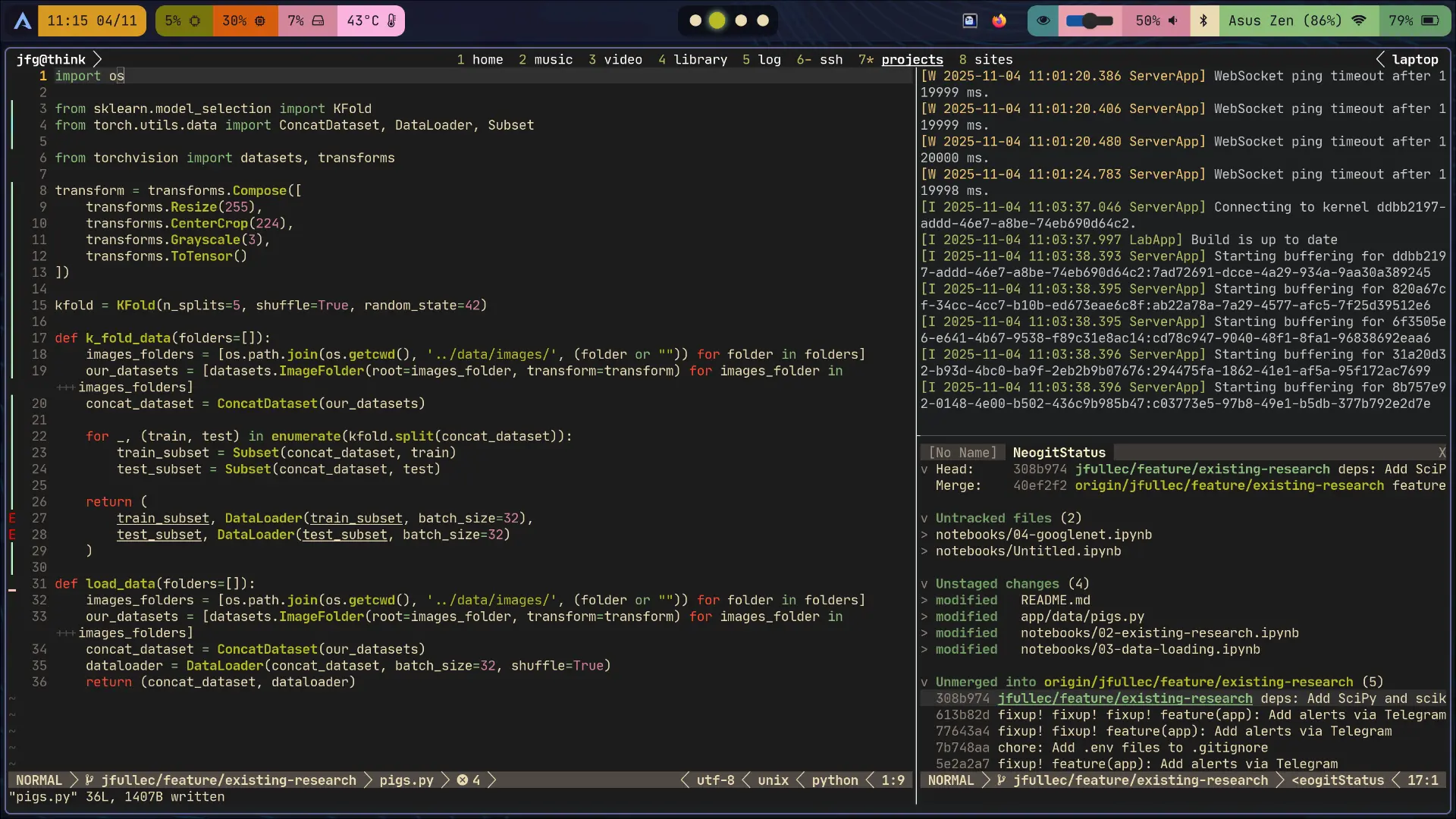
With my laptop docked I have two decent displays (and have no use for a third),
so I wanted to turn the screen off automatically. I can do this with hyprctl,
a command line control utility for Hyprland.
#!/usr/bin/env bash

if [ "$(acpi -a)" == "Adapter 0: on-line" ]; then
  hyprctl keyword monitor "eDP-1, disable"
else
  hyprctl keyword monitor "eDP-1, enable"
fi
Map this to an autorun in your config and you're laughing.
bindl = , switch:on:Lid Switch, exec, ~/.config/hypr/scripts/lid-closed
Book review: The Shockwave Rider by John Brunner (1975)
I'm sure you're familiar with the Cyberpunk genre. Man on the run from a surveillance system, hacking into the mainframe to stay one step ahead, might bump into a love interest, definitely remains cynical throughout.
There's some discussion about the first Cyberpunk novel. Everyone thinks of Neal Stephenson's Snow Crash from 1994, or William Gibson's Sprawl trilogy from 1984, but there's one book that predated both, and that book is John Brunner's The Shockwave Rider. Give it a read.
The term Computer Worm comes from this book!
GPU poverty
I'm currently without a good graphics card, so I've been doing some training on my laptop's CPU. Even when just training a final layer it takes a while (one project takes ten minuntes per epoch), so I'm looking into alternatives.
-
Hosted GPUs. Paperspace offers such a service.
-
Hosted notebooks. Google Colab is an example, but doesn't fit my use case, and I use PyTorch, not TensorFlow.
-
Hosted services. AWS SageMaker is an option.
-
Building my own box. You don't need a gaming PC for this, just a workstation and a GPU. Here's a guide.
VPNs
Tailscale replaced OpenVPN and ssh -L for me. No
more OpenVPN server, just a Tailscale instance, and I can securely access
machines in that group without exposing ports on any device. It uses
WireGuard magic and works really well, and it
traverses NAT for you, so it doesn't require any uPnP horrors. Never port
forward again!